
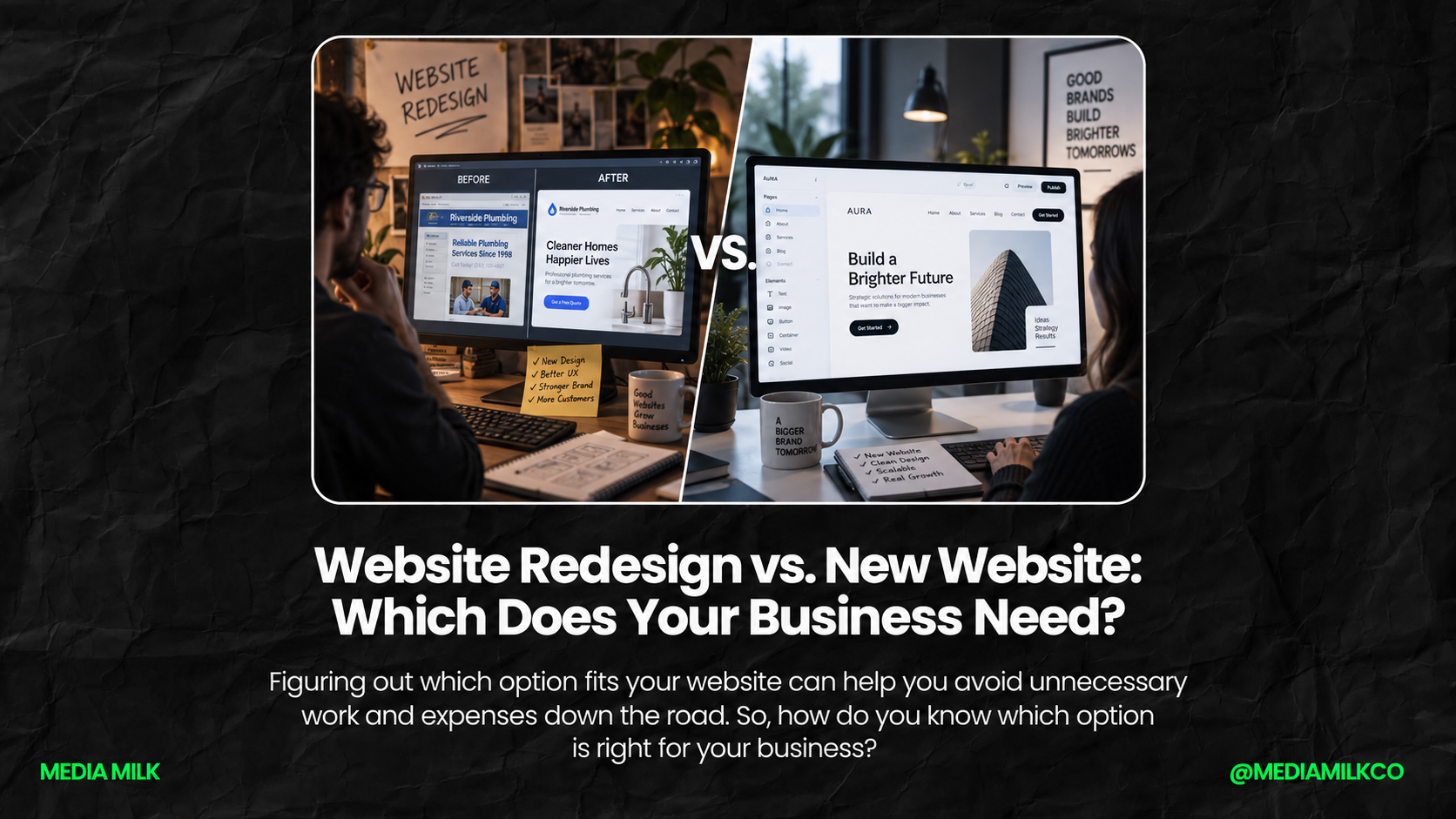
Website Redesign vs. New Website: Which Does Your Business Need?
Your website may be one of the first things a potential customer sees when they find your business. That means an old or hard-to-use website can cost you customers, even if the rest of your business is doing a great job.
But does that mean you need to throw out your current website and start over? Not always.
Sometimes a redesign is enough. Other times, the problems go much deeper, and building a new website makes more sense.
Figuring out which option fits your website can help you avoid unnecessary work and expenses down the road. So, how do you know which option is right for your business?
First, What Is a Website Redesign?
A website redesign means you keep the basic website but make important changes to improve it. You might update the look, rewrite the content, replace old photos, improve the navigation, or make the site work better on phones. The basic structure may stay in place.
Think of it like fixing up a house. The house is still there, but you paint the walls, replace the floors, update the kitchen, and fix things that are no longer working well.
A redesign can be a good choice when your website still has a solid foundation.
What Does a New Website Mean?
A new website is more like starting with a clean slate.
The design may be completely different. The pages may be reorganized. The site may move to a new platform or use a different system behind the scenes. Sometimes the old website has so many problems that fixing it would take almost as much work as building something new. In that case, starting over can make more sense.
The important thing is not to choose a new website simply because a new website sounds exciting. Choose it because your current site is no longer doing the job.
Signs Your Website May Only Need a Redesign
Let’s start with the easier situation.
Your website may still have a good foundation, but it needs some attention.
The Design Looks Old
Maybe your website was built several years ago and still looks almost exactly the same.
That does not automatically mean it is bad.
But if the design feels dated, your photos are old, and the layout makes your business look behind the times, a redesign could help.
You may not need to change everything.
New photos, cleaner pages, better spacing, updated colors, and a simpler menu can give the site a much fresher look.
Your Information Is Still Correct
This is a big one. If your services, prices, hours, phone number, address, and other important details are mostly correct, you already have useful material to work with. You may simply need to organize it better.
A redesign can help customers find the information they need without making you rebuild the entire site.
Your Website Works, But It Is Hard to Use
Maybe the pages load, but finding information takes too many clicks. Perhaps your contact form is buried. Maybe customers have trouble finding your services or figuring out how to book an appointment. These are often problems a redesign can solve.
Your website should make life easier for visitors, not make them hunt for answers.
W3C, the organization that develops international web standards, recommends clear and consistent navigation, easy-to-identify interactive elements, and clear instructions as part of accessible web design.
Your Site Looks Fine on a Computer but Not on a Phone
This is a serious problem today.
Many people visit your website on their phones. If the text is tiny, buttons are difficult to tap, images do not fit the screen, or visitors have to move the page from side to side, you have a problem.
Google uses the mobile version of a website’s content for indexing and ranking. Google also strongly recommends having a mobile-friendly site.
If your website is otherwise in good shape, improving the mobile experience may be part of a redesign rather than a reason to start over.
Signs You May Need a New Website
Sometimes the problems are bigger.
The Website Is Built on an Outdated System
Technology changes. A website built many years ago may depend on old software, outdated plugins, or a platform that is difficult to update. If your developer has to work around old systems every time you want to make a change, it may be time to move on.
This is especially true if making simple updates has become expensive or risky. A new website can give you a cleaner system that is easier to manage in the future.
Nobody Knows How to Update It
This happens more often than you might think. A business owner may have a website that was built by someone years ago. That person is no longer available, and nobody else knows how the site works.
Now every small change becomes a project. If your team cannot easily update basic information, add a new service, publish a blog, or change a photo, a new website may be worth considering.
You should not have to call a developer every time you need to change your business hours.
The Website Has Too Many Problems
One small problem is one thing. But what if there are broken links, outdated pages, confusing menus, slow-loading images, poor mobile performance, old forms, and other issues all at once?
At some point, fixing one problem after another may stop making sense.
Building a new site lets you create something that fits the way your business operates now, rather than spending time trying to make an older site keep up with changes it was never designed to handle.
Your Business Has Changed
Maybe your company has grown. You started with three services and now offer ten. Perhaps you opened another location. Maybe you changed your target customer or started selling products online.
Your old website may no longer match what you actually do. When the business has changed in a major way, a new website can give you a chance to rethink the whole customer journey.
Instead of squeezing new information into an old structure, you can build the site around the business you have now.
Don't Forget About Website Speed
A website can look great and still be frustrating if it is slow.
Google’s Core Web Vitals measure real-world aspects of a page’s loading speed, responsiveness, and visual stability. Google recommends that site owners aim for good Core Web Vitals to support a good user experience.
You do not need to become a web developer to understand the basic idea. If pages take too long to load, images jump around while the page opens, or buttons take too long to respond, visitors may get frustrated.
Sometimes these issues can be fixed without rebuilding the entire site. Other times, poor performance is tied to the way the website was built. That is when a new website may be the better long-term answer.
Think About Accessibility, Too
A website should be usable by as many people as possible. That includes people with disabilities who may use screen readers, keyboard controls, captions, or other tools to browse the web.
The W3C Web Content Accessibility Guidelines, known as WCAG, provide an international standard for making websites and digital content more accessible. The current WCAG 2.2 standard includes guidance around things such as readable content, keyboard use, navigation, forms, and other parts of the user experience.
Accessibility is not something you should think about only after a website is finished.
If you are building a new site, it is better to include accessibility from the beginning. W3C notes that doing so can be more efficient than trying to fix accessibility problems later. Even if you only need a redesign, accessibility should still be part of the conversation.
What About SEO?
This is another reason businesses sometimes hesitate to change their website. You may worry that redesigning or rebuilding the site will hurt your Google rankings. That concern is understandable.
A website change should be planned carefully, especially if your current site already brings in traffic from search engines.
Pages may need to be redirected. URLs may change. Important content needs to be moved. Search engines need to be able to find and understand the new pages.
A new design does not automatically mean better rankings.
Google says its systems focus on helpful, reliable, people-first content and a good overall page experience.
So don’t rebuild your site just because you want a different color or a trendier homepage. Make changes because they will improve the experience for your customers.
Ask These Questions Before You Decide
Before choosing between a redesign and a new website, sit down and make an honest list of what is wrong with the current site.
Ask yourself:
Does the website still represent our business? If yes, a redesign may be enough.
Can customers find what they need quickly? If not, your navigation and page structure may need work.
Does the site work well on phones? If not, this needs to be fixed either way.
Can we update the website without a lot of trouble? If every change is difficult, your current system may be holding you back.
Is the technology still supported and secure? If the answer is no, rebuilding may be the safer choice.
Has the business changed a lot since the site was built? If your company has grown or changed direction, a new website may give you a better foundation.
Would fixing everything cost almost as much as starting over? This is an important question.
If you are going to replace most of the pages, rebuild the navigation, change the platform, fix the mobile experience, and repair technical problems, you may already be doing most of the work involved in a new website.
Don't Let a New Design Distract You From the Real Problem
There is a common mistake businesses make when updating their websites. They focus too much on how the website looks.
Of course, design matters. But a beautiful website that is difficult to use is still a bad website. Your new or redesigned site should help people answer basic questions quickly:
What does this business do?
Can they help me?
Where are they located?
How much does it cost?
How do I contact them?
What should I do next?
The answers will be different for every business, but the goal is the same: make the customer’s job easier.
So, Which One Does Your Business Need?
If your website still works well at its core but feels dated, has weak content, or is a little difficult for visitors to use, updating the existing site could be the better choice.
If the site is built on outdated technology, is difficult to manage, has serious technical problems, or no longer fits your business, a new website may be the smarter choice.
And sometimes the answer is somewhere in the middle.
You may need a major rebuild of the back end while keeping parts of your existing content. Or you may be able to keep your current platform while giving the entire front end a fresh look.
There is no rule saying every business needs to start from zero.
The Bottom Line
Before you spend money on a new website, figure out what is actually wrong with the one you have.
If the foundation is good, improve it. If the foundation is causing problems, start fresh. Either way, the goal should not be to have the newest-looking website in town.
Your website has a job to do. It should help people understand your business, find the information they need, trust what they see, and take the next step.
If your current site is doing that well, you may not need to replace it. If it is getting in the way, it may be time for a change.
And sometimes the best website decision is not about choosing between old and new. It is about building something that finally works for the business you have today.
Media Milk helps businesses turn better branding, smarter marketing, and stronger digital experiences into real growth. From getting found online to creating content people actually notice, we help your business attract more attention, build more trust, and convert more customers.
What We Can Do For You:
Website Design & Development
Search Engine Optimization (SEO)
Social Media Management
Branding & Graphic Design
Content Creation
Digital Advertising
Related Articles:
Categories:
SEO & Search Visibility
Social Media Content
Branding & Creative
Advertising & Lead Generation
Business Growth
Need some help?
Click the button below to schedule a hassle-free consultation and see how Media Milk can help your business grow.