
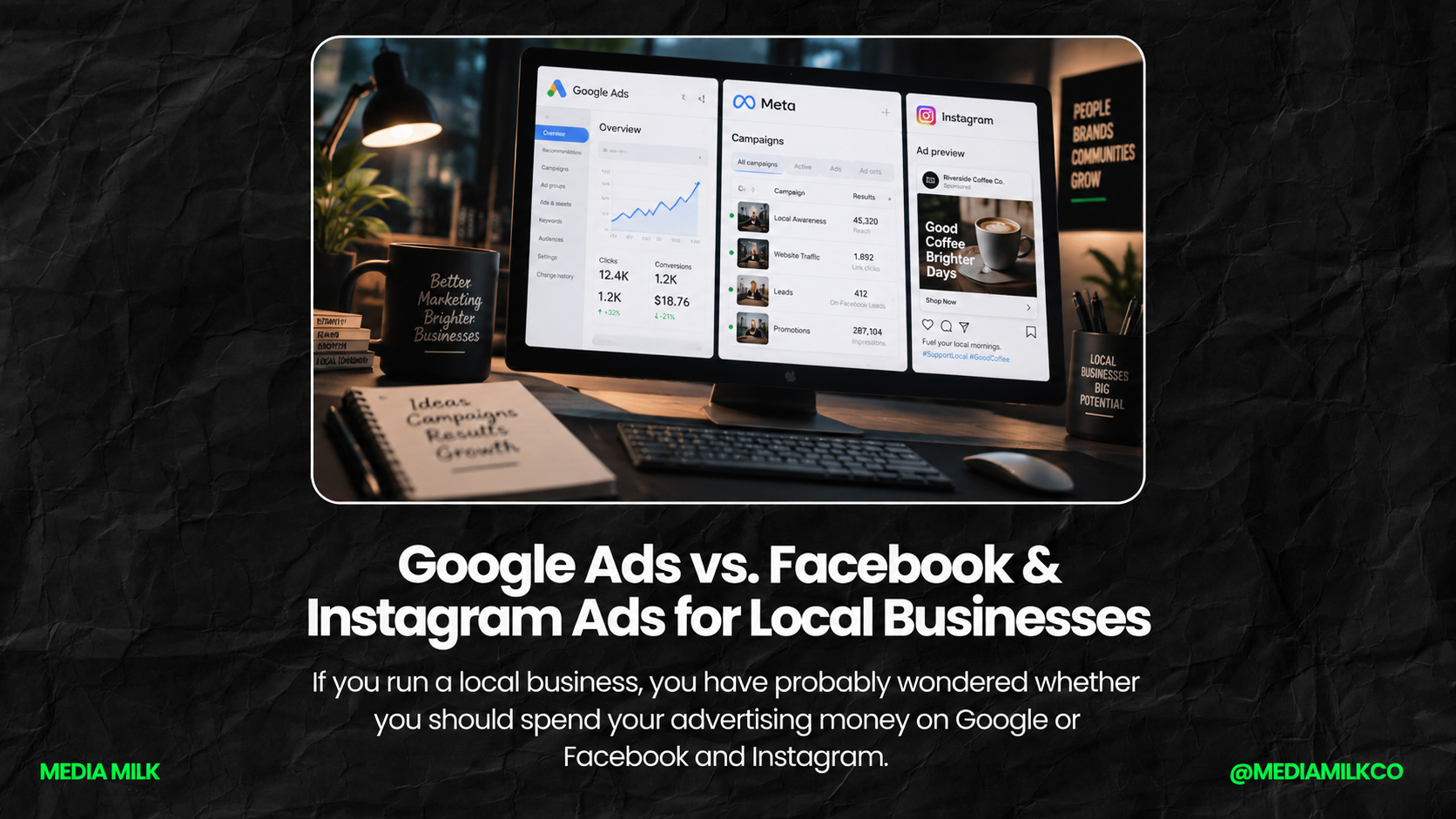
Google Ads vs. Facebook & Instagram Ads for Local Businesses
If you run a local business, you have probably wondered whether you should spend your advertising money on Google or Facebook and Instagram.
Both can put your business in front of potential customers. But they work in different ways. That difference matters.
Someone searching Google for “plumber near me” is already looking for a plumber. Someone scrolling through Instagram may not need a plumber at that moment. They may simply stop because they see an interesting ad.
Neither approach is automatically better. The right choice depends on what you sell, who you want to reach, and what you want people to do after seeing your ad. So, before putting money into either platform, it helps to understand how each one works.
Google Ads Reach People Who Are Looking
Think about what happens when someone needs something right away.
Their sink starts leaking. They search for a plumber.
They need a dentist. They search for a nearby dentist.
They want to replace their driveway. They search for local paving companies.
This is where Google Ads can be useful.
Google allows businesses to target specific geographic areas, including cities and areas around a location. Businesses can also use location information connected to their Google Business Profile in eligible campaigns.
That means a local business can focus its ads on the places it actually serves instead of trying to reach everyone. For some businesses, that can be a big advantage.
Facebook and Instagram Ads Work Differently
Facebook and Instagram ads are more about reaching people based on who they are, what they do, and what may interest them.
Instead of waiting for someone to search for your business, you can put your business in front of them while they are browsing social media. This can work well when the product or service is something people enjoy seeing.
A local restaurant might show a photo of a new dish. A hair salon could show a recent style. A gym could share a short workout video. A clothing store might highlight a new collection.
Meta also supports ads across Facebook and Instagram, including visual formats such as Reels. Meta says Reels ads are designed for mobile and can be used to support different business goals.
The person may not have been searching for your business. Your ad gives them a reason to stop and take a look.
The Biggest Difference: Intent
This is one of the easiest ways to understand the difference between the two platforms.
Google often catches people when they are looking for something.
Facebook and Instagram often introduce people to something they were not actively looking for.
Imagine you own a local roofing company. Someone searches Google for: “Roof repair near me”. That person may have a problem they want to solve right now.
Now imagine that same person is scrolling through Instagram and sees a roofing company showing a before-and-after project. They may stop and look at it. They might not need a new roof today. But if they have noticed a problem with their roof, your business may come to mind later.
Both situations have value. They simply happen at different points in the customer’s decision.
When Google Ads May Make More Sense
Google Ads can be a strong option when people regularly search for the service you offer.
This is common with businesses such as:
- Plumbers
- Electricians
- Dentists
- Lawyers
- HVAC companies
- Auto repair shops
- Roofers
- Cleaning companies
- Emergency services
People often look for these businesses when they have a specific need. Google’s local ad options can also help businesses drive actions such as calls, directions, website visits, and store visits. That can be important for a local service business.
If someone searches “emergency plumber near me” at 8 p.m., you do not need to convince them that plumbing is useful. They already know.
You need to show them why they should choose your business.
When Facebook and Instagram Ads May Make More Sense
Social ads can be a better fit when the visual side of your business matters. Think about businesses where people like to see the product before they buy.
A restaurant can show food. A salon can show hair transformations. A fitness studio can show classes. A clothing store can show outfits. A home improvement company can show finished projects.
These ads can also be useful for businesses that want people to discover them before they are ready to buy.
You may not get an immediate phone call from every person who sees your ad. That does not mean the ad failed. Someone may see your business today, visit your profile next week, and contact you later. The path to becoming a customer is not always immediate.
Google Is Not Just About Search
It is easy to think of Google Ads as nothing more than the text ads that appear at the top of a search page. There is more to it.
Google Ads can connect with local business information and can help businesses appear across Google properties. Based on the type of campaign you choose, your local business may show up in places like Google Search or Google Maps when nearby customers are looking for what you offer.
That can be useful for a business that depends on people finding a nearby location.
For example, a customer searching for a coffee shop nearby may be able to see useful business details such as an address, hours, phone number, reviews, and photos.
For local businesses, those details matter.
Social Ads Give You More Room to Show Your Business
One big advantage of Facebook and Instagram is the visual space.
Instead of trying to explain everything in a short search ad, you can use a photo or video to show people what you do.
A restaurant can make someone hungry with a close-up video of a meal. A landscaper can show a yard before and after the work. A salon can show a color transformation. A contractor can walk through a finished renovation.
That type of content can help people understand your business without a long explanation.
Meta’s advertising tools also support different placements and creative formats, including Facebook and Instagram Reels.
Which One Costs Less?
This is where you should be careful. There is no simple answer to “Which platform is cheaper?”
Advertising costs can change based on your location, industry, competition, audience, campaign goal, ad quality, and many other factors.
A click on Google may cost more than a click on Facebook in one market. In another market, the opposite may be true.
More importantly, a cheaper click does not always mean a better result.
Suppose you spend $300 on ads. Campaign A gets 100 clicks. Campaign B gets 40 clicks. At first glance, Campaign A looks better. But what if Campaign A produces two customers while Campaign B produces eight? The second campaign may be far more valuable even though it received fewer clicks.
That is why local businesses should look beyond clicks and likes.
Pay attention to calls, form submissions, bookings, purchases, direction requests, and actual sales when those actions can be measured.
Your Website Matters More Than You Might Think
Even a good ad can struggle if the page people reach is confusing.
Imagine someone clicks your ad for a local cleaning service. They land on a page with no phone number, no clear service information, and no easy way to request a quote. You may have paid for the click, but the customer has nowhere useful to go.
After someone clicks your ad, they should immediately understand how to take the next step, whether that means calling you, requesting a quote, booking an appointment, or making a purchase.
If you want people to call, make your phone number easy to find. If you want bookings, make the booking button clear. If you want quote requests, keep the form simple.
Do not make people work to become customers.
So, Which Should You Choose?
For many local businesses, the answer is not necessarily Google or Facebook and Instagram. It may be Google first, then social.
If people are already searching for your service, Google can help you reach them at a useful moment.
After getting your search advertising in place, you can use Facebook and Instagram to keep your business on people’s radar, share what you do, and introduce your brand to people who may need you later.
For other businesses, especially highly visual businesses, social ads may be a great place to start. And some businesses may benefit from testing both. The key word is testing.
Do not assume one platform will work simply because another business says it worked for them. Your customers are different. Your location is different. Your offer is different.
A Simple Way to Decide
Ask yourself a few questions.
Do people search for my service when they need it? If yes, Google may deserve a closer look.
Does my business have products or services that look good in photos or videos? If yes, Facebook and Instagram could be useful.
Do customers usually make quick decisions, or do they need time to think? A business that solves an urgent problem may benefit from search ads. A business that sells something people like to browse may get more value from social ads.
Can I track what happens after someone clicks? If you cannot tell whether your ads are bringing calls, leads, bookings, or sales, it will be much harder to know whether your money is working.
Don't Forget About Organic Marketing
Paid ads are only one part of local marketing. Your Google Business Profile, website, reviews, social media pages, and regular content can all play a role.
Google’s local advertising options can use information from a linked Business Profile, including details such as your address, hours, photos, and reviews. That means your paid advertising does not exist on its own.
If someone sees your ad and then checks your business online, everything they find should support the same message.
Your hours should be correct. Your phone number should work. Your website should be easy to use. Your reviews should be visible. Your social media should not look abandoned.
The ad gets their attention. The rest of your online presence helps them decide what to do next.
The Bottom Line
Google Ads and Facebook and Instagram ads can both work for local businesses. They just do different jobs.
Google is often strongest when someone is already looking for what you sell.
Facebook and Instagram can be useful for showing people what you offer and getting your business in front of potential customers while they browse.
There is no universal winner.
Instead of asking, “Which platform is best?” ask: “Where are my customers, and what are they doing before they become my customers?”
That question will usually lead you in the right direction.
Start with a clear goal. Set a realistic local audience. Give people a good reason to choose you. Track what happens after the click.
And most importantly, judge your ads by the business they bring in—not by how impressive the numbers look on the advertising dashboard.
Media Milk helps businesses turn better branding, smarter marketing, and stronger digital experiences into real growth. From getting found online to creating content people actually notice, we help your business attract more attention, build more trust, and convert more customers.
What We Can Do For You:
Website Design & Development
Search Engine Optimization (SEO)
Social Media Management
Branding & Graphic Design
Content Creation
Digital Advertising
Related Articles:
Categories:
SEO & Search Visibility
Social Media Content
Branding & Creative
Advertising & Lead Generation
Business Growth
Need some help?
Click the button below to schedule a hassle-free consultation and see how Media Milk can help your business grow.